Thursday, March 4, 2010

Prague blog! Ou Prague Blague?

Resized_HPIM5071

Prague never made it on our list of places we should see while we live in Europe. But when we realized it was only 3 hours or so from Berlin we decided we had to stop for a night.

Of course, I am glad we did.  Check this out: “Situated on the Vltava River in central Bohemia, Prague has been the political, cultural and economic centre of the Czech state for more than 1100 years. For many decades during the Resized_HPIM4992Gothic and Renaissance eras, Prague was the permanent seat of two Holy Roman Emperors and thus was also the capital of the Holy Roman Empire.”

Wow! It is also the 6th most visited European city after London, Paris, Rome, Madrid and Berlin. (How cool is it that I’ve been to 5 out of the top 6!? Hmm… guess Madrid needs to go on our list…).

Also, Prague is in a country we had never visited, the Czech Republic.  They speak a language that neither André or I can understand a word of.  They are part of the EU but still have not adopted the Euro, using kroners instead. I was excited to see what these looked like!

We got there a bit late (due to the car trouble that morning) and just hung out at our Bed and Breakfast eating cooler food for dinner.  When we travel, I always carry a cooler full of snacks, etc., to save money and for times when we are too tired to go out. This bed and breakfast rivaled the one we stayed in in Ireland, which I also adored.  The rooms were absolutely enormous and so fancy!  I felt like we were being given permission to hang out in a museum!  The people were incredibly nice and the breakfast the next morning even included eggs and fresh rye bread (yum!)  It was less than a 5 minute walk from town center and the price, for 2 rooms plus breakfast for 5 was only 100 Euros (off season).  Total bargain.  Thanks to my friend Caroline for the recommendation!  If you ever want to visit the website is: http://www.dumuvelkeboty.cz/  Here are some photos of our luxurious surroundings.

Resized_HPIM5007Resized_HPIM5009 Resized_HPIM5015 Resized_HPIM5017 

The next morning we were ready to see the town.  First we headed to Prague Castle.

Resized_HPIM5018Resized_HPIM5021 Resized_HPIM5023 Resized_HPIM5026 Resized_HPIM5030

The kids were in a great mood this day and were playing beautifully together.  Zander was the professer who had adopted 2 kids, Dawn and Charlie after their father (his best friend) had tragically fallen to his death while leaning too hard against a bridge railing that suddenly collapsed.     This kept them happy for about 2 hours.  I love their imaginations.  Every time we got to a bridge, the professor kindly reminded the kids not to lean against the railing, because “remember what happened to your father!”

There were guards at the castle gates that (unlike the others we’ve seen) were seemingly allowed to move their heads and alter their expressions.  I even saw one smile…  I was impressed by the statues over the gate showing warriors at battle (see left).

Within the castle walls is the oldest Gothic Cathedral in Central Europe.  St. Vitus.  Of course we went in for a look.  Thanks to wikipedia for last two photos….

Resized_HPIM5033 Resized_HPIM5035

Then we walked through the town heading for the old Jewish ghetto of Prague.  So much to see!


Resized_HPIM5055 Resized_HPIM5056 Resized_HPIM5062 Resized_HPIM5063 Resized_HPIM5066

Resized_HPIM5072

Resized_HPIM5075As loyal readers know, we’ve probably seen at least 100 cathedrals since we began traveling. What we haven’t seen, yet, are synagogues.  We were very interested when we saw some shown on the map and headed over.  Unfortunately, it turned out that all the synagogues and Jewish history museums in Prague had banded together and in order to get into any of them, you had to pay to get into all of them – for our family it would be over 50 Euros to enter and there was no option to pay to enter only one location.  Very, very frustrating!  I was particularly interested in seeing the Prague ghetto since it is still a functioning vibrant part of the Prague community. 

Of course, I became interested in the etymology of ghetto since modern usage makes me think of inner city slums as ‘ghettos’.  In fact, the word was originated in Venice to describe the location of their Jewish population and then expanded to include such enclaves of Jews all over Europe.   “Jewish ghettos in Europe existed because Jews were viewed as alien due to being a cultural minority and due to their non-Christian beliefs in a Renaissance Christian environment. As a result, Jews were placed under strict regulations throughout many European cities. The character of ghettos has varied through times. In some cases, the ghetto was a Jewish quarter with a relatively affluent population (for instance the Jewish ghetto in Venice). In other cases, ghettos were places of terrible poverty and during periods of population growth, ghettos had narrow streets and tall, crowded houses. Residents had their own justice system. Around the ghetto stood walls that, during pogroms, were closed from inside to protect the community, but from the outside during Christmas, Pesach and Easter Week to prevent the Jews from leaving during those times.” There is evidence these communities existed as early as 1084.    Now the word ghetto has evolved to mean any place that groups of minorities are concentrated under less than ideal circumstances.

The Prague ghetto is particularly interesting since it includes the legend of the Golem.  I had run into this story before in a children's version I got out at the library.   This is how it goes:

“Under Rudolf II, the Holy Roman Emporer, the Jews in Prague were to be either expelled or killed (a pogrom). To protect the Jewish community, the rabbi constructed the Golem out of clay from the banks of the Vltava river, and brought it to life through rituals and Hebrew incantations. As this golem grew, it became increasingly violent, killing gentiles and spreading fear. A different story tells of a golem falling in love, and when rejected, he became the violent monster as seen in most accounts. Some versions have the golem eventually turning on its creator and perhaps even attacking other Jews.

The Emperor begged Rabbi Loew to destroy Golem, promising to stop the persecution of the Jews. To deactivate Golem, the rabbi rubbed out the first letter of the word "emet" (truth or reality) from the creature's forehead leaving the Hebrew word "met", meaning dead. The Emperor understood that the Golem's body, stored in the attic genizah of the Old New Synagogue, would be restored to life again if needed. Accordingly, the body of Rabbi Loew's Golem still lies in the synagogue's attic, although some versions of the tale have Golem stolen from the genizah and entombed in a graveyard, where now the great Zizkovska tower stands. A recent legend is told of a Nazi agent ascending to the synagogue attic during WWII and trying to stab Golem, but perishing instead. At any rate, the attic is not open to the general public.”

Awesome, right?  But, since we were unwilling to pay 50 Euros for a 15 minute visit, there was no chance to try to break into the attic and see Golem.

Resized_HPIM5085 Resized_HPIM5089 Resized_HPIM5091 Resized_HPIM5092 Resized_HPIM5108Resized_HPIM5110

We wandered around Old Town Square and saw the cool Astronomical Clock go off at 11am.  You can see the kids on top of a giant pile of snow –facing the clock tower.  I think the snow piles were their favorite thing in the city.  We got lost a bit trying to find a good place to eat and ended up having something random.  We then walked across Charles Bridge which began being built in 1357. It has played a role in many other parts of Prague's history and the mortar is supposed to have egg shells in it.    Also the INXS hit “Never Tear us Apart” was inspired by the history of this bridge.

The architecture in Prague was amazing but I particularly enjoyed the 20’s style Art Deco buildings. Here are some great examples…

Resized_HPIM5098 Resized_HPIM5105 Resized_HPIM5120 HPIM5106

Resized_HPIM5116Another thing I loved in Prague were the shops.  They seem to have a ton of Amber aResized_HPIM5115nd Garnet jewelry everywhere in this city!  Despite the overwhelming amounts of the stuff, it wasn’t really very affordable but I loved looking at it!  Also there were lots of matreshkas and interesting art galleries and glass blowing studios….  I had a great time window shopping and even bought a small amber pendant for myself with the last of our kroners at a place that was going out of business and had it all 50% off!  We finally hopped in the car, heading for Munich by nightfall (we hoped!)

I think we could have easily spent a week in Prague though – what a great city.

Dresden

So, we headed out early Wednesday morning.  We were to sleep in Prague, but stop along the way, in Dresden.  This was so we could see the reportedly beautiful town and also visit the famous Green Vault – known to be the largest treasure house in all of Europe.

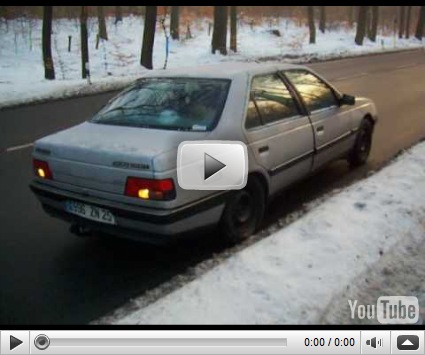
Unfortunately, things did not go precisely as planned.  It turns out that Mr. Liberty’s parking brake had frozen to the back tire.  This meant we couldn’t really move our car since one wheel didn’t turn at all.  Believe it or not we got out onto the main road without too much problem since the thick layer of ice on the side streets allowed us to slide that wheel along.  But then, obviously, we couldn’t go anywhere without burning rubber.

Words can not really describe what our car was doing.  Please see the (took me forever to upload) videos below:

We were distraught (OK, actually André and I were distraught and the kids thought it was yet another grResized_HPIM4942and adventure).  I ended up enlisting the help of Regis and Marie.  They informed us (most tactfully) that you never,  ever, ever, EVER, EVER!!!! use your parking brake in winter. (Who knew? I’m pretty sure they never covered that in Driver’s Ed.)   They helped us find a local garage and we eventually made it there.  Of course, by the time we got there (about 9am) the brake had loosened and we could drive safely once more.   We headed for Dresden and the vault.

We got there only half an hour after our timed tickets and (wonder of wonder, miracle of miracles) they still let us in!  So, we did get to see the Green Vault.  But no photos were allowed, security is super tight.  I’m afraid you will have to only imagine the room dedicated to ivory, the rooResized_HPIM4948m dedicated to gold, the room dedicated to silver, the room dedicated to jewels, the room dedicated to obscenely wealthy but practically useless utensils and drinking vessels……..(I could go on).  It was done in a way that was almost tasteful and, somehow not all that overwhelming.  Simply put, it was awesome.  Better than the crown jewels in London, that’s for sure!

Here is a shot of a unicorn/snail thing they had on a poster outside.  This kind of fantastical creation was pretty typical of the stuff we got to see. I think I may have been most wowed by the diamond jewelry and the vessels (glasses, bowls etc…) carved out of pure quartz or amethyst. 

After the vaulview of Brühl's Terrace at twiglightt, we just walked around the city.  Dresden needs some good PR firm since I had never heard of it (except for maybe they make china or something?) but it is probably one of the most beautiful cities I have ever seen (and by now I’ve seen more than a few). It was a part of former East Germany.   It was heavily, heavily bombed near the end of WWII.  In fact, 90% of the city center was destroyed (see photo right) and nearly wiped off the map.  Kurt Vonnegut's Slaughterhouse Five is based on the experiences he had in the city at the time of the bombing.  In fact, the bombing of Dresden is one of the most controversial attacks in WWII and killed no less than 18,000 civilians.  Here is one survivor’s account from Wikipedia:

It is not possible to describe! Explosion after explosion. It was beyond belief, worse than the blackest nightmare. So many people were horribly burnt and injured. It became more and more difficult to breathe. It was dark and all of us tried to leave this cellar with inconceivable panic. Dead and dying people were trampled upon, luggage was left or snatched up out of our hands by rescuers. The basket with our twins covered with wet cloths was snatched up out of my mother's hands and we were pushed upstairs by the people behind us. We saw the burning street, the falling ruins and the terrible firestorm. My mother covered us with wet blankets and coats she found in a water tub.

We saw terrible things: cremated adults shrunk to the size of small children, pieces of arms and legs, dead people, whole families burnt to death, burning people ran to and fro, burnt coaches filled with civilian refugees, dead rescuers and soldiers, many were calling and looking for their children and families, and fire everywhere, everywhere fire, and all the time the hot wind of the firestorm threw people back into the burning houses they were trying to escape from.

I cannot forget these terrible details. I can never forget them.

—Lothar Metzger, survivor

The city had made the barriers between cellars thin, so one could run to the next cellar if their house was on fire.  Unfortunately, every house on the whole street, for several blocks was on fire.  The tragic result was dozens of dead piled up in the cellar at the end of the block. There were so many dead bodies everywhere burial was impossible.  The local militia was sent out with flamethrowers to burn the bodies.   The photo at right is of a huge pile of bodies.

The attackers deliberately created a firestorm in the town.  This type of system is so intense it simply sucks all the oxygen right out of the air. Dresden was not the only place that got this treatment during WWII.  The Allies used firebombing enough to create firestorms in: Hamburg, Kassel, Braunschwieg, Darmstadt, Heilbronn, Pforzheim, Wurzberg (all in Germany) plus Tokyo and Kobe (in Japan).  Resulting casualties (mostly civilian) top 255,000.  Of course that doesn’t count the nuclear bombings of Hiroshima and Nagasaki (which killed at least another 200,000).  This may be billed as the war won by the ‘good guys’ but, if you ask me, there are no real winners when it comes to war.

Thankfully, much has been put into reconstructing Dresden and you would never know it was so devastated to see it today.   Around every corner was a new surprise, and even just turning my head at a new angle often brought me gasps of amazement.  Semper Opera House, TheatrePlatz, views of the Elbe river – all breathtaking.

Resized_HPIM4943 Resized_HPIM4950 Resized_HPIM4954 Resized_HPIM4956 Resized_HPIM4959 Resized_HPIM4962 Resized_HPIM4966 Resized_HPIM4969 Resized_HPIM4971

It all looks super old, right?  Who would know they rebuilt a great parResized_HPIM4973t of it less than 50 years ago?

I think this photo (at left) is my favorite.  The kids sliding on the frozen ice in the moat surrounding the palace walls.

We all had a great time sliding around on the ice and just enjoying the fact we were walking on frozen water!  It really is quite amazing that something that was liquid can turn solid enough to support us.  Thank you water, you are another miracle I tend to take for granted….

We headed onward toward Frauenkirsch (or The Church of our Lady).  This building had been heavily firebombed but had been rebuilt fairly recently – only finished in 2008.

Here is how it looked as recently as 1991 (at left) and here is how it looks today (at right).  Notice how, during the rebuild, they purposely used white new stone to mingle with the older gray stone.  This way you could really see how heavy the damages were and how much work was involved to rebuild it.  I like it when they do that kind of thing.

Resized_HPIM4989 Resized_HPIM4990


The inside appeared to be completely restored and gorgeous.  It seems all white interiors and raised galleries are far more common in Germany than in any of the other countries we have visited.  The only sign of damage was the original (I think) cross from the tower which showed how melted it was from heat damage.

And now we head to Prague…

Wednesday, March 3, 2010

Sachsenhausen

Tuesday was to be our last day in Berlin and we decided to visit Sachsenhausen Concentration Camp.  The language to use around this stuff is super tricky.   This is an important blog to me and it’s been hard for me to write. I feel awful saying I was looking forward to visiting.  It seems kind of macabre to admit that I’ve always wanted to see a concentration camp.  I’m not sure how one can couch this in terms that don’t seem, well, totally insensitive. 

On the other hand, there is no denying that these camps are a huge draw for tourists. We did the tour with Berlin walks and joined a group of about 20 other thrill (?) seekers heading to the suburbs of Berlin.  I know our hosts were a bit mystified as to why we would bring our young children to such a place.  We also have read them children’s-level books about the Holocaust and took them to see The Anne Frank House when we were in Amsterdam.   I guess I don’t worry too much about scarring their psyches by exposing them to the past.  They do understand at some level what is happening but seem pretty good at taking things they can handle in, and tuning the rest out.  Much of it goes over their heads and if some stuff doesn’t, and it makes them upset, I think, honestly, that is good.  It was terrible, it should make them upset and it should make them realize that such things were not the right way to solve problems.   

I was thinking about this a bit more and I thought:  Hey, are my opinions on showing the kids concentration camps at all inconsistent with other opinions I hold dear?  I am thinking, in particular, of the fact that I have not let the kids watch anything more than G rated movies unless I am in the room (for the first time, at least). In fact, they haven’t ever seen even a PG-13 or R rated movie.  The only PG ones they’ve seen are Goonies, The Princess Bride, Mamma Mia, RV, Space Camp, Cannonball Run, War Games and (admittedly borderline) Robin Hood Prince of Thieves and The Pirates of the Caribbean.  No Spiderman, Batman, X-Men stuff, Harry Potter just yet (although I’ve really been wanting to share the old Star Wars with them as of late – hard to find in France).  Also, I don’t have them playing violent video games (or any video games really, except those found at PBS kids) In general, I think it is not good to expose them to this type of violence.  I think it desensitizes them and makes them think blowing things up, etc… is  usually a good solution.  They did that stuff so the good guys can beat the bad guys or, alternately, to entertain us.  Plus, Hollywood promotes the fantasy that the good guys all survive and the bad guys get defeated.

What do you think?  Am I a big hypocrite?    But, back to Sachsenhausen….

Resized_HPIM4905

The first thing we passed, walking from the train station, was a monument to Todesmarsch.  As the Allies pinched in on the Germans and they knew they were losing, they began herding all the able bodied (and I use that term loosely) remaining camp inmates on a forced march.  From this camp, over 3000 of them were forced to march, non stop, for over 100km.  Keep in mind they were already weak and starving.  Of course about 600 of them simply dropped from exhaustion and were then shot in the back of the head.  Eventually, the remaining guards fled to save their own hides and the prisoners had to wander onward, eventually stumbling into the Russian army, who helped them.

Resized_HPIM4910 Resized_HPIM4913 The next thing we saw was the entrance gate, where all the prisoners were processed.  We learned more than I had ever known before about concentration camps.  The history of them, the way they began and how they grew.  In general, Sachsenhausen was used for political prisoners.  In the early days of Hitler’s power he imprisoned all his political enemies in order to shut them all up.  Sachsenhausen was not a death camp, but rather a work camp (about 100,000 people died at Sachsenhausen as opposed to 1.25 million at Auschwitz).  Each morning the prisoners had to line up for a head count and were then sent to work.  They walked through the gate with the slogan “Arbeit Macht Frei” or “Work Makes You Free”.  In the later years of the war, the camp was so over crowded (including not only political prisoners, but Jews, and POW’s) they were running out of work.  Some people’s ‘work’ became simply standing, unmoving, for 10 hours straight.  Other people were involved in going through all the valuables of other Jews that had been killed… can you imagine?

It is well known, of course, that 6 million Jews died (as well as hundreds of thousands of others) in concentration camps.   I had heard of The Final Solution but what we realized at this place was that the goal of the Third Reich wasn’t just killing the Jews.  It was erasing them.  I mean, if you kill someone, and you kill their parents, and all their brothers and sisters and even their extended family, would anyone remember them?   Well (you are thinking), yes, right?  Their neighbors?  Not the way people come and go, I would say.  How about friends and classmates?  Maybe yes today – but back then the Jews did not, in general, intermingle with non-Jews.  The Germans isolated them, herded them into ghettos and then loaded them like cattle into trains.  They ransacked their homes, stole their possessions, tortured and killed them.  They also burned all their documents and records as if they were never, ever born.  Of course, it didn’t work – but I do see some sort of difference between ‘normal’ genocide and this attempt to make it seem as if an entire group of people simply never were.  And the fact is, there are people today that say the Holocaust never happened – and all the evidence was fabricated.  Chilling…..

When the guards would count the prisoners each day, they would write the number down.  At the end of the day thResized_HPIM4915e numbers would have to match.  If there were more prisoners, they’d shoot the extras.  If there were less, a manhunt would be called and the prisoners would have to wait, standing up, until the escapees were captured and returned, even if it was winter and it took all night and the next day as well.(no coats, hats or even shoes)  Of course, this would all be in an attempt to discourage escapes.   Resized_HPIM4916Almost no one ever did escape this prison.  The entire complex, in the early years, could be controlled by the guard house, pictured left, since there was a giant rotating machine gun that could wipe out the entire camp in the hands of only 2 gunners.  Also there was what they benevolently referred to as the “Neutral Zone”.  This was a section of gravel before the barbed wire and then outer fences. If a prisoner was unfortunate enough to set foot in the Neutral Zone he would be neutralized (i.e. shot instantly without warning). 

We had a woResized_HPIM4920nderful guide who told us many stories.  At one point they had the prisoners testing new combat footwear for the German troops – that entailed issuing prisoners shoes a size too small and having them run on them, over rocky ground, nonstop, for 6 hours a day.  (Guess then they would check for holes in the shoes).  We visited the barracks of the prisoners, saw their bathrooms and the medical experimentation area.  We got to see the monument put up in honor of the Homosexual prisoners, which, for many years was not allowed Resized_HPIM4929to be included since homophobia is still very strong in Germany.

Later in the war, more people were dying in this camp due to many reasons, primarily the lack of food, proper health care and increased overcrowding.  Any soldier working in the camp had carte blanche with prisoners.  They were permitted to torture, maim or kill any prisoner when the mood struck.

This camp only ever housed adult men, no women or children (although they did experiment with infecting some small boys with typhus in the medical wing) but, since so many were dying they were sending trucks filled with bodies to crematoriums downtown daily.  One truck overturned, and the bodies of the emaciated and sore-ridden concentration camp victims tumbled out into the street. 

For a generatioResized_HPIM4928n or more, the German people had been brainwashed into believing that the Jews were dangerous criminals that needed to be in prison.  The average German was not interested in helping the prisoners and was, indeed, afraid of them.  At the same time, however, the government was feeding everyone propaganda implying that the people in the camps were receiving the best of care and rehabilitation.  A bunch of emaciated corpses were not good for PR so they did the only logical thing.  Hush the incident up as quickly as possible and build their own crematorium at the camp.  They started running loud classical music to cover the screams of those who died in the gas chambers and the others who were shot in the ditch near the ovens. Then they burned their bodies, so many that, near the end, the oven almost never stopped running.  When a person was murdered in a camp, as I mentioned earlier, they not only killed them, they burned them and they burned all their papers and records.  They mixed their ashes and buried them as well, and there are surely tons that have never been uncovered.  It is all so very very tragic and sad.  These enemies weren’t just used as scapegoats.  They weren’t just abused and killed.  They tried to change the history of the world so these ‘types of people’ were never a part of the story… it’s truly horrifying. 

Of course, I have studied WWII, have read about the Holocaust. I even know people who had family who died in the Holocaust.  Now, I’ve even been to a concentration camp, seen the ovens and gained a context for what I have learned.  I wonder why it is, even with all that, it just doesn’t feel real.  I’m not saying I don’t believe it. I do.  But I guess there is a Resized_HPIM4935part of me, still, that doesn’t want to believe that such a thing could have happened.  Even though I know it did and still, I know, is happening in another way, in places like Darfur.  When I read about how cities were bombed and civilians killed during war, I feel more than just sad or frustrated – there is a true empathy going on – a  type of emotional connection.  I can imagine a world where I might be the victim of such atrocities so it cuts close to home. I feel afraid.   For whatever reason, though, when I think about what the victims of the Holocaust went through, I don’t feel the same fear.  Of course (obviously) I feel sad, frustrated, angry. I shed tears…. But, for some reason, on a deeper level, I feel safe from that kind of persecution. I can’t truly imagine that ever happening to me and mine.  Is it because I have Christian roots?  Is it because I am white?  Is it because I’m from the ever so insulated America?  I don’t really get it…. and I feel, well, kind of guilty about it! 

I mean, obviously, my kids are learning about it, they are being educated not to hatResized_HPIM4938e, not to judge others by appearances or beliefs.  I don’t think this visit had too much of an impact on them, though, since Callie and Griff played in the snow the whole time and Zander couldn’t even remember what this place was when he saw the photos in the blog.  (“Um…. I know – that’s that bad place!")  Scarred for life, they are not.  In German schools they teach the war heavily and all the kids have to visit one of these camps in high school to be faced with it.  But yet, there are neo-nazis in the US, Austria and Germany – probably all around the world.  I know I was brought up thinking these things were wrong as well -  and what good is that doing the world these days?   It seems like there are just so many other children now who are learning to hate and fear.  Either because they are being attacked and bombed by outsiders (Iraq, Afghanistan, Darfur etc…) or Resized_HPIM4937because they are simply being taught that you should never take care of others if it might, in any way, threaten your ability to take care of yourself or your Resized_HPIM4939 own family (the health care debate).  I know many people who, when they hear something they don’t agree with, just say they ‘don’t believe in that’.  Evidence or facts have nothing to do with changing their opinion on it – they just don’t believe, and that’s that.    Jews are evil.  Homosexuality is a choice.  Evolution is not real….  Is this related?  Is it not?  I’m definitely babbling…

We headed back home  for one last supper with our friends.  They took such great care of us!  Of course there was the food and beds, but more importantly, there were the conversations!  I hope, one day, they will visit Philadelphia and we can return the  favor.  We will miss you guys!

Tuesday, March 2, 2010

Easier to comment on our blog (we hope)

So we hear that our attempts to make commenting easier on our site has actually made it harder--here goes another try, we disabled the requirement to read a picture and type it in. Let us know if you have any problems!

Followers

Contributors


hit counter